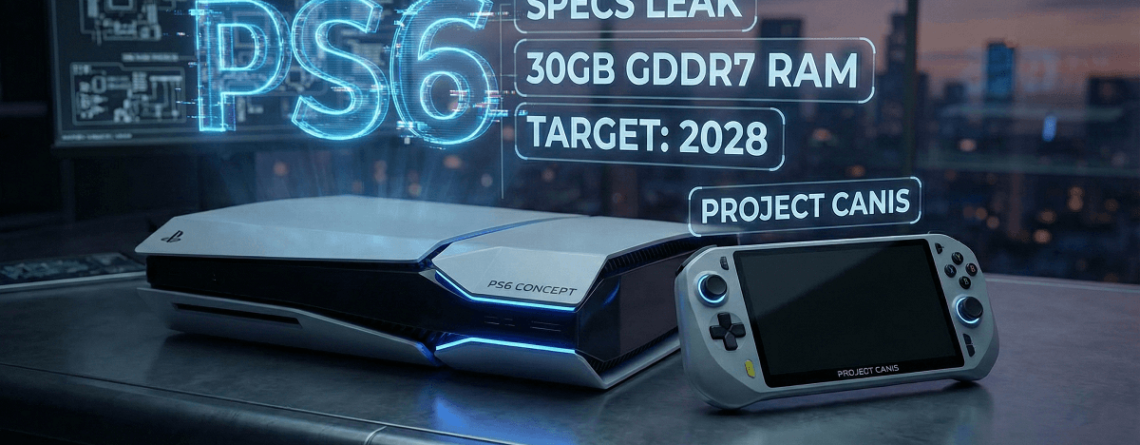
PS6 Specs Leak: Why the 30GB GDDR7 RAM Rumor Changes Next-Gen Gaming
An expert analysis of the latest PlayStation 6 rumors, release windows, pricing economics, and the potential return of a handheld companion.
Sony hasn’t officially announced the PlayStation 6 yet, but the leak cycle has already gone into overdrive. The latest bombshell: credible hardware leaker Kepler L2 claims PS6 will ship with 30GB of ultra-fast GDDR7 RAM on a 160‑bit bus, delivering around 640GB/s of bandwidth—up from 16GB GDDR6 and 448GB/s on PS5. If this holds, it fundamentally changes how next‑gen games can be built, how AI systems run in real time, and how Sony positions PS6 against PS5 Pro and Microsoft’s next Xbox, codenamed “Magnus”.







The most prevalent and disruptive rumor currently circulating amongst silicon industry insiders involves a massive upgrade to the console’s memory architecture. We aren’t just talking about a speed bump; we are talking about a fundamental shift in capability.
As developers hit the ceiling of current hardware, the PS6 represents the promise of unbridled creativity. Based on current supply chain chatter, patent filings, and historical cycles, here is an authoritative breakdown of what the PS6 landscape looks like, starting with that game-changing RAM rumor.
What are the expected PS6 specs? The 30GB GDDR7 Breakthrough
If the current leaks are accurate, the single most defining characteristic of the PS6 will be its memory pool. Multiple sources suggest Sony is targeting 30GB of GDDR7 RAM for the system’s unified memory.
To put this in perspective, the base PS5 launched with 16GB of GDDR6. A jump to approximately double the capacity, combined with the significantly faster speeds of the next-gen GDDR7 standard, is not mere incrementalism—it’s a necessary evolution for photorealistic gaming.
Why does this matter? It’s not just about higher resolution textures. In 2026, gaming relies heavily on AI-driven upscaling (like Sony’s PSSR) and frame generation. These technologies are memory-hungry. Furthermore, true “Path Tracing”—the holy grail of lighting that goes beyond simple ray tracing—requires immense amounts of fast memory to store light bounce data without choking the GPU. 30GB removes the bottleneck that currently forces developers to choose between high fidelity and high frame rates.
Other Rumored Core Specs:
CPU: Likely a custom AMD Zen 6 architecture (prioritizing multi-core efficiency for complex simulations).
GPU: A custom AMD architecture based on UDNA (Unified DNA) or RDNA 5, specifically designed for path tracing acceleration.
Storage: PCIe Gen 6 NVMe SSD, aiming for speeds exceeding 14GB/s to eliminate load times entirely.
Sony PS6 vs. PS5 Pro: Is the rumored 30GB RAM Upgrade Worth the Wait?
This is the crucial question for consumers in 2026. If you just purchased a PS5 Pro, should you feel buyer’s remorse? Absolutely not.
The PS5 Pro is the apex of the current generation, designed to maximize existing game engines. The PS6 is being built for engines that don’t fully exist yet.
The PS5 Pro utilizes smart upscaling to achieve near-4K images at good frame rates. The PS6, with 30GB of RAM and Zen 6 processors, is aiming for native 4K at a locked 120fps, or perhaps even 8K at 60fps, with full path tracing active.
PS5 Pro (official/confirmed):
CPU: 8‑core/16‑thread Zen 2 (same basic architecture as PS5)
GPU: 16.7 TFLOPs RDNA‑based, ~45% faster rendering than PS5
Memory: 16GB GDDR6 @ 18Gbps (576GB/s) + 2GB DDR5 for OS
Highlights: AI upscaling (PSSR), stronger ray tracing, 2TB SSD, better bandwidth.
PS6 (rumored):
CPU: Next‑gen Zen 6 cores with more advanced efficiency and IPC
GPU: RDNA 5, likely with much higher ray‑tracing and AI throughput
Memory: 30GB GDDR7, ~640GB/s bandwidth
Highlights: Designed for 4K120 with heavier RT, more AI, and larger worlds.
From a pure hardware perspective, 30GB GDDR7 vs 16GB GDDR6 is huge. For players:
If you’re on base PS5, PS5 Pro is a strong mid‑gen upgrade now.
If you’re a late‑generation buyer or you already own PS5 Pro, PS6’s jump in memory, CPU architecture, and GPU sophistication will bring a far bigger generational leap.
The Verdict: If you want the best experience today, enjoy the PS5 Pro. The PS6 is the device that will power games in 2029 and 2030 that simply cannot run on today’s hardware.
What is the PS6 release date? (vs. Xbox 2027)
Predicting console launches requires analyzing historical patterns and current chip fabrication timelines. Sony has reliably stuck to a 6-to-8-year console lifecycle.
PS4: 2013
PS5: 2020
PS6 Projection: Late 2027 or Late 2028.
Industry consensus currently leans heavily toward a Holiday 2028 launch. This gives the PS5 Pro enough breathing room to dominate the market and allows the necessary 2nm or 1.8nm chip manufacturing processes to mature and become cost-effective.
Who Will Launch First: Sony or Microsoft? Microsoft’s recent strategy shifts suggest they are keen to disrupt the traditional cycle. Rumors of the next Xbox aiming for a 2027 release could force Sony’s hand. However, Sony historically prefers to launch a more polished, powerful box slightly later, rather than rushing to beat the competition by a year.
PS6 vs. Next-Gen Xbox (Magnus): Different Philosophies
The rivalry will continue, but the strategies are diverging.
Sony’s Approach (PS6): Brute force local power. The 30GB RAM rumor reinforces that Sony believes the best gaming experience happens inside the box under your TV, minimizing reliance on internet speeds for core processing.
Microsoft’s Approach (Codename Magnus): Rumors suggest the next Xbox may adopt a “hybrid” strategy. While it will have potent local hardware, it may lean heavily on cloud-assisted computing to handle complex physics or AI processing, theoretically allowing it to “punch above its weight” without expensive local components.
The PS6 will likely win on raw spec sheets; the next Xbox may win on ecosystem flexibility.
Will PS6 Launch with a Handheld? “Project Canis” and the Hybrid Future
The success of the Steam Deck and Nintendo Switch has proven that high-fidelity portable gaming is not a fad; it is a requirement for modern gamers. Sony cannot ignore this segment again.
Enter the rumors of “Project Canis.”
PS6 Design Concepts: Why a Dedicated Handheld Companion is More Likely Than You Think While some hope for a “PS Vita 2” standalone console, industry analysis suggests a different route. It is highly probable that the PS6 will launch alongside—or integrate with—a dedicated handheld companion device.
Unlike the PlayStation Portal, which is purely a streaming device, “Project Canis” is rumored to have enough native processing power to play indie titles or older PS4 classics locally, while serving as the ultimate low-latency streaming companion for full-fat PS6 games when at home. This “hybrid-lite” approach secures the PlayStation ecosystem lock-in without fragmenting the developer base with a separate portable platform.
The Economics of Gaming: PS6 Price Prediction
We have entered the era of the premium console. The days of the $399 launch price for flagship hardware are likely gone forever.
The Cost of PS6: Analyzing Inflation and Component Costs The cost of cutting-edge silicon is rising exponentially as fabrication nodes shrink to 2nm. Furthermore, packing 30GB of GDDR7 RAM into a consumer device is an immensely expensive proposition. Add global inflation and logistics costs to the mix, and the BOM (Bill of Materials) for the PS6 will be significantly higher than the PS5.
Will Sony Break the $1,000 Barrier in India? For the US market, a launch price of $599 or even $699 for the standard disc-based PS6 seems inevitable by 2028.
For the Indian market, the outlook is steeper. Given India’s import duty structures (which often add 30-50% to electronics costs) and currency fluctuations, a $699 US price tag often translates to significantly more.
If the US price hits $699, it is highly probable that the PS6 launch price in India could hover around ₹75,000 to ₹85,000, effectively breaking the psychological $1,000 conversion barrier. Sony will need to demonstrate immense value—via exclusives and that massive spec jump—to justify that entry cost.
Final Thoughts: Should You Wait for PS6?
It fits:
Sony’s need to support heavier ray tracing, AI upscaling, and increasingly massive open worlds.
AMD’s transition to Zen 6 and RDNA 5 in the console window of 2027–2028.
A market where Microsoft is reportedly preparing a more expensive, more PC‑like hybrid Xbox.
If you’re on base PS5 and want better 4K today, PS5 Pro is a strong mid‑gen option. But if you’re comfortable waiting 2–3 years and want a truly next‑gen jump—especially for 4K120, advanced ray tracing, and AI‑driven games—the leaked PS6 + Canis ecosystem looks like a significant step beyond anything in the current generation.
As always, until Sony speaks publicly, treat every spec and price as provisional. But all signs suggest that PS6 will be the start of a genuinely premium, AI‑heavy console era—where 30GB of GDDR7 isn’t overkill, it’s the new baseline